The point is narrow and legal: Implementing Regulation (EU) 2026/1427 is a Commission authorising act, not another scientific “green light”. From 23 July 2026 one specific novel food — enzymatically produced egg membrane hydrolysate — may be placed on the EU market after inclusion in the Union list, under the name, dose and labelling conditions in the act. This is not a general authorisation of every egg membrane hydrolysate. In the ingredients list, the official designation of the entire novel food is not “collagen peptides”.
1. What exactly did the Commission authorise?
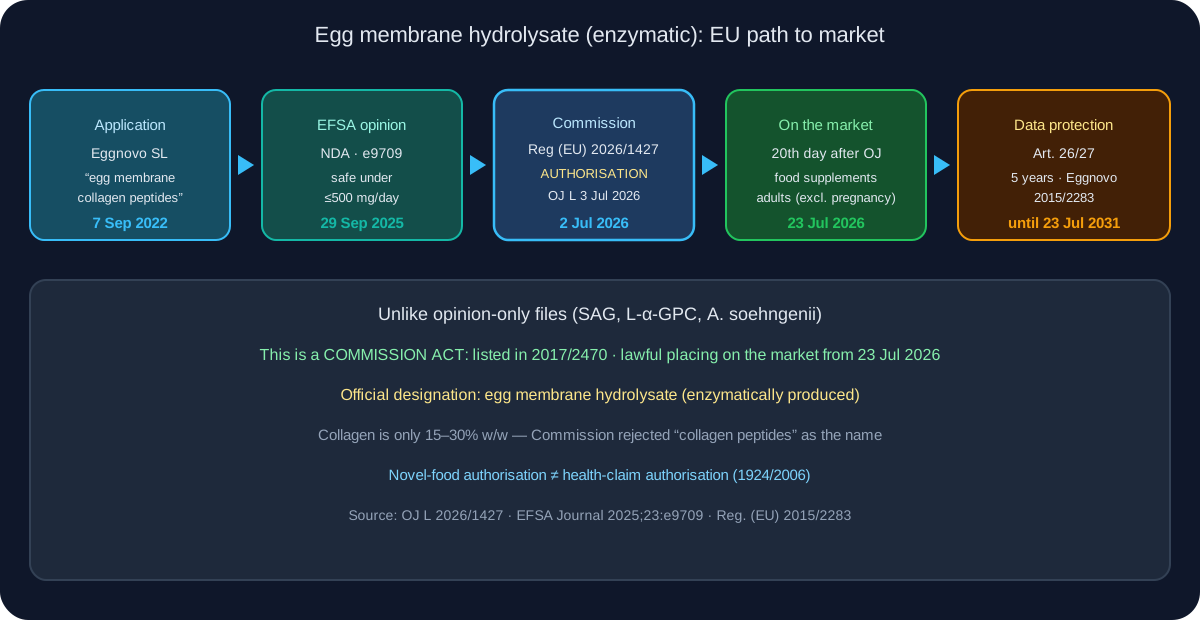
Document 32026R1427 (ELI: http://data.europa.eu/eli/reg_impl/2026/1427/oj) was published in OJ L, 2026/1427, 3.7.2026. Entry into force: the twentieth day after publication → authorised placing on the market of this novel food from 23 July 2026.
The subject of the act is specific. Article 1 provides that egg membrane hydrolysate (enzymatically produced) is authorised to be placed on the market within the Union and shall be included in the Union list of novel foods set out in Implementing Regulation (EU) 2017/2470. “Full authorisation” is shorthand only. It is not a general authorisation of every egg membrane hydrolysate, every technology, or every supplier using a similar commercial name.
Applicant: Eggnovo SL, Av. de los Tilos nº 5, 31132 Villatuerta, Navarra, Spain. Application filed on 7 September 2022 as “egg membrane collagen peptides”, for food supplements ≤500 mg/day, for adults excluding pregnant and lactating women.
The NDA Panel opinion Safety of egg membrane collagen peptides… (EFSA Journal 2025;23:e9709, DOI 10.2903/j.efsa.2025.9709), adopted 29 September 2025, concluded safety under the proposed conditions. The Commission went further: it listed the ingredient and — critically for labelling — did not keep the application’s working name as the novel-food designation.
2. Name, warning, allergen — three separate duties
The Commission found that the name “egg membrane collagen peptides” does not reflect the composition of the novel food, because the collagen content is only 15–30% w/w. The Union-list name is therefore egg membrane hydrolysate (enzymatically produced), and the designation on the labelling of food supplements containing it is “egg membrane hydrolysate”, or the equivalent in the language of the Member State.
According to EFSA opinion e9709, collagen peptide content is 15–30%. That is not “collagen” in the sense of the entire protein fraction. The act’s specification sets crude protein at ≥70% w/w and the parameter “collagen” at 15–30% w/w. Collagen peptides are a fraction of the composition, not the identity of the whole hydrolysate. That sentence stands. The clarification is numerical and sourced, not a slogan.
What the label must keep apart
- The novel-food name. In the ingredients list: “egg membrane hydrolysate”. That is the designation under Regulation 2026/1427, not a marketing substitute.
- The warning required by Regulation 2026/1427. The labelling of food supplements containing this ingredient shall bear a statement that they should not be consumed by persons under 18 years of age or by pregnant and lactating women. That is a warning duty from the authorising act, separate from the ingredient name.
- The “egg” allergen declaration under Regulation (EU) No 1169/2011. Eggs are listed in Annex II; Article 21 requires the allergen to be indicated and emphasised. The ingredient is obtained from chicken egg membranes, so it must be emphasised in the ingredients list as an allergen — regardless of whether egg protein is detected in the finished hydrolysate. That is an information duty about origin, not the result of a batch laboratory test.
3. Specification and limits (Table 2 of the act)
The authorised product is a protein hydrolysate obtained by enzymatic (papain) hydrolysis of chicken (Gallus gallus domesticus) egg membranes. Form: water-soluble cream-yellowish powder.
| Parameter / obligation | Value or condition |
|---|---|
| Category | Food supplements (Directive 2002/46/EC) |
| Maximum dose | 500 mg/day |
| Population | Adults; excluded: persons under 18 and pregnant or breastfeeding women |
| Crude protein | ≥70% w/w |
| Collagen peptides / collagen | 15–30% w/w. EFSA opinion: collagen peptide content 15–30%, not the entire protein fraction. Act specification: parameter “collagen” 15–30% w/w |
| Moisture | ≤8% |
| TAMC | ≤5×10⁴ CFU/g |
| TYMC | ≤100 CFU/g |
| E. coli | absence / 10 g |
| Salmonella | absence / 25 g |
| L. monocytogenes | absence / 25 g |
| Novel-food name | In the ingredients list: egg membrane hydrolysate. “Collagen peptides” does not replace that designation |
| Warning under 2026/1427 | separate statement: not for persons under 18; not for pregnant or lactating women |
| Allergen (1169/2011) | egg — emphasised in the ingredients list regardless of whether egg protein is detected in the finished hydrolysate (Annex II, Art. 21) |
| Data protection | until 23 Jul 2031 — data used in Eggnovo SL’s procedure (Arts 26/27 Reg. 2015/2283); not exclusivity of the whole category |

4. Two Union-list entries — a similar name does not carry conditions across
An earlier entry does exist in the Union list. Implementing Regulation (EU) 2018/1647 authorised egg membrane hydrolysate from 25 November 2018 (applicant: Biova, LLC). According to the 2018 EFSA opinion (DOI 10.2903/j.efsa.2018.5363) it is a hydrolysate produced by alkaline treatment; the act’s specification describes a patented solubilisation after hydromechanical separation of the membranes. Limit: 450 mg/day. The labelling designation is also “egg membrane hydrolysate”. Data protection for that entry ended on 25 November 2023.
The 2026/1427 entry is a different novel food: the enzymatic hydrolysate (papain) based on Eggnovo’s data, limit 500 mg/day, data protection until 23 July 2031. An identical or similar list-entry name does not allow use of the other entry’s conditions. Material from the alkaline process does not “fit” the 500 mg limit or the enzymatic specification — and the reverse is equally true. The enzymatic hydrolysate does not ride the 2018 entry merely because the label can also say “egg membrane hydrolysate”. What decides is the identity of the novel food: process, specification and the specific row in list 2017/2470.
| 2018 entry — 2018/1647 | 2026 entry — 2026/1427 | |
|---|---|---|
| List name | egg membrane hydrolysate | egg membrane hydrolysate (enzymatically produced) |
| Process | alkaline (EFSA 2018); in the act: patented solubilisation | enzymatic (papain) |
| Limit | 450 mg/day | 500 mg/day |
| Applicant | Biova, LLC | Eggnovo SL |
| Data protection | until 25 Nov 2023 — ended | until 23 Jul 2031 — procedural data, not category exclusivity |
5. Data protection until 2031 — not exclusivity of the category
Under Articles 26 and 27 of Regulation (EU) 2015/2283 the Commission granted five-year protection of the data used in the authorisation procedure. The act covers identity, production process and allergenicity data. Beneficiary: Eggnovo SL. End date: 23 July 2031.
That is protection of data used in the procedure, not absolute market exclusivity of the whole egg-membrane-hydrolysate category. The 2018 entry is the practical proof: another hydrolysate with a related name is already on the list, on its own conditions and its own limit.
The consequence for this specific novel food (the enzymatic one) is narrower and follows the act: during the protection period it may be placed on the Union market by Eggnovo SL, unless a subsequent applicant obtains an authorisation without reference to the protected data or with Eggnovo’s agreement. Another operator may therefore obtain their own authorisation on the basis of independent data. They may not rely on Eggnovo’s protected dossier for their application or placing on the market.
6. Novel-food authorisation ≠ health claim
Regulation 2026/1427 gives no basis for joint, cartilage or bone claims. Novel-food status does not automatically exclude all claims — but it is not itself a basis for a joint, cartilage or bone claim. Any such claim needs a separate legal basis under Regulation (EC) No 1924/2006. Suggesting “supports joints because it is a novel food” has no footing in the authorising act and does not transfer clinical efficacy onto the label.
7. Poland: GIS after EU authorisation
EU authorisation opens placing on the Union market of this novel food under the list conditions. Notification to the Chief Sanitary Inspector (GIS) is not an additional novel-food authorisation. It is a separate obligation related to placing a specific food supplement on the Polish market.
The product notified to GIS must match the correct entry: ingredients-list name, dose ≤500 mg/day, population (adults; excluded: persons under 18 and pregnant or breastfeeding women), the 2026/1427 warning, egg allergen emphasis, and the enzymatic specification. A wrong official name or dose is an inspection risk — even with a Union-list entry in place. GIS does not “complete” the novel-food authorisation and does not legalise material from another process.
8. Producer / importer checklist
- Confirm the right entry — 2026/1427 + the enzymatic row in 2017/2470. The 2018/1647 entry (alkaline, 450 mg/day) exists and does not carry its conditions across.
- Ingredients-list name — egg membrane hydrolysate. “Collagen peptides” does not replace the official designation of the entire novel food.
- Dose and population — ≤500 mg/day; adults; excluded: persons under 18 and pregnant or breastfeeding women.
- Three labelling layers — novel-food name; warning under 2026/1427; egg allergen under 1169/2011, emphasised regardless of protein detection.
- Data protection — Eggnovo data protected until 23 Jul 2031. Not category exclusivity. An own authorisation is possible on independent data.
- Joint / cartilage / bone claim — the novel-food act does not provide it; a separate basis under 1924/2006 is required.
- GIS (PL) — notification of the specific supplement, not a second novel-food authorisation.
Conclusion
Unlike recent EFSA opinions without a Commission act, enzymatic egg membrane hydrolysate has an authorisation of a specific novel food and an entry in the Union list. That is not a general authorisation of every egg membrane hydrolysate. The market for that entry is open from 23 July 2026, but narrow: an ingredients-list designation that is not replaced by “collagen peptides”, 500 mg, adults excluding persons under 18 and pregnant or breastfeeding women, a separate warning from the act, the egg allergen regardless of protein detection, Eggnovo data protection until 2031 (with room for an own authorisation on independent data), and no automatic joint, cartilage or bone claims. The honest message: a safety authorisation opens lawful use of this ingredient under the list conditions — it does not open a “for joints” claim and it does not replace a GIS notification.
Primary sources
- Commission Implementing Regulation (EU) 2026/1427 — Document 32026R1427; ELI eli/reg_impl/2026/1427/oj; OJ L, 2026/1427, 3.7.2026. Authorisation of egg membrane hydrolysate (enzymatically produced) and amendment of list 2017/2470.
- EFSA NDA Panel. Safety of egg membrane collagen peptides… EFSA Journal 2025;23:e9709. DOI: 10.2903/j.efsa.2025.9709 — opinion of 29 Sep 2025; safety under ≤500 mg/day; collagen peptide content 15–30%.
- Commission Implementing Regulation (EU) 2018/1647 — earlier “egg membrane hydrolysate” entry; 450 mg/day; on the list from 25 Nov 2018; data protection until 25 Nov 2023.
- EFSA NDA Panel. Safety of egg membrane hydrolysate as a novel food. EFSA Journal 2018;16(7):5363. DOI: 10.2903/j.efsa.2018.5363 — alkaline treatment of the earlier hydrolysate.
- Regulation (EU) 2015/2283 — novel foods; Arts 26/27 data protection.
- Implementing Regulation (EU) 2017/2470 — Union list of novel foods (both entries).
- Regulation (EU) No 1169/2011 — food information; egg allergen (Annex II, Art. 21).
- Directive 2002/46/EC — food supplements.
- Regulation (EC) No 1924/2006 — nutrition and health claims (separate legal basis).