The legal point is narrow: Liao et al. (2026) do not prove that an omega-3 supplement “damages the brain”, and algal oil does not automatically earn a cleaner health claim. Regulation (EC) No 1924/2006 asks for an authorised food–health relationship and a dose. It does not ask whether the DHA came from anchovy, krill or Schizochytrium.
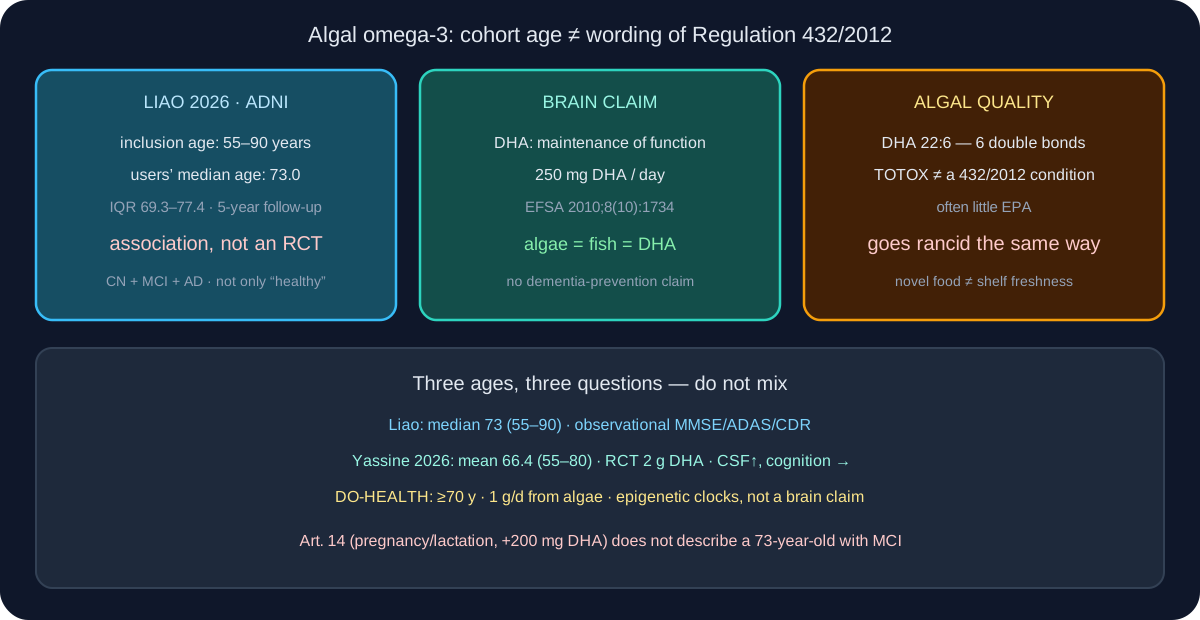
1. How old were the participants?
Zheng-Bin Liao et al., J Prev Alzheimers Dis 2026;13(6):100569, doi:10.1016/j.tjpad.2026.100569, used ADNI. Inclusion age: 55–90 years. After matching on age, sex, APOE ε4 and diagnosis: 273 omega-3 users vs 546 non-users.
| Parameter | Users (n = 273) | Non-users (n = 546) |
|---|---|---|
| Age, median (IQR) | 73.0 (69.3–77.4) | 73.5 (68.2–78.5) |
| Inclusion range | 55–90 years | |
| Median follow-up | 5 years (IQR 3–8.5) — not the “six years” in viral posts | |
| Diagnosis | CN, SMC, MCI and AD dementia — not only healthy older adults | |
| APOE ε4 | 43.6% | 45.4% |
Median 73, with MCI and AD in the mix, changes the reading: people already on a cognitive path may be more likely to take a capsule (indication bias). That age does not match the Art. 14 claim on foetal and breastfed-infant brain development (Reg. 440/2011: extra 200 mg DHA for pregnant and lactating women).
2. What the study showed — and did not
Exposure: self-reported omega-3 supplement use in ADNI. Outcome: faster MMSE decline (β = −0.266, p < 0.001), rising ADAS-Cog13 (β = 0.823) and CDR-SB (β = 0.205). Mediation via FDG hypometabolism (30.8% / 40.8% / 19.0%). No mediation by Aβ, tau or grey-matter atrophy.
The authors wrote “may be associated”, not “proved”. Not an RCT. Dose, form (TAG vs ethyl ester), source (fish / flax / algae), capsule TOTOX and adherence are unknown. US questionnaires often file flaxseed oil — ALA, not DHA — under the same “omega-3” box. Transferring the result to Schizochytrium oil is a category error.
3. EU brain claims: what is on the list
Commission Regulation (EU) No 432/2012 (Art. 13(1) of 1924/2006):
- “DHA contributes to maintenance of normal brain function” — food ≥40 mg DHA/100 g and 100 kcal; the consumer is told that the beneficial effect is obtained with 250 mg DHA per day. EFSA Journal 2010;8(10):1734 and 2011;9(4):2078 (IDs 565, 626, 631 and others).
- “DHA contributes to the maintenance of normal vision” — same 250 mg DHA.
- “EPA and DHA contribute to the normal function of the heart” — 250 mg EPA+DHA combined. Many algal oils are DHA-dominant: a heart claim needs the EPA arithmetic, not the word “algae”.
- Art. 14: maternal DHA intake contributes to normal brain development of the foetus and breastfed infants — extra 200 mg DHA on top of 250 mg EPA+DHA for adults (Reg. 440/2011). That is not a claim for a 73-year-old with MCI.
EFSA authorised maintenance of normal function in the general population, not Alzheimer prevention, not “memory improvement”, not “slowing brain ageing”. The 2010 opinion did not establish a separate effect on “cognitive function in the elderly”. Yassine 2026: 2000 mg DHA reached CSF, no hippocampal or RBANS difference at 24 months (age 55–80). ASCEND (diabetes, 1 g/day, 7.4 years): dementia RR 1.00.
4. Weaknesses of algal omega-3 quality
Algal marketing rests on three slogans: vegan, no food-chain methylmercury, “the same DHA the fish started with”. Peroxidation chemistry does not read the brief.
4.1. Six double bonds remain
DHA (22:6 n-3) from Schizochytrium / Ulkenia / Crypthecodinium fermentation is the same carbon skeleton as cod-liver DHA. Liao et al. themselves note that the highly unsaturated structure — DHA in particular — makes it the lipid most prone to peroxidation in brain mitochondria. That is an argument that freshness of the acid, not the kingdom of the organism, decides what the consumer swallows.
4.2. TOTOX, PV, p-AV: algae are not automatically in spec
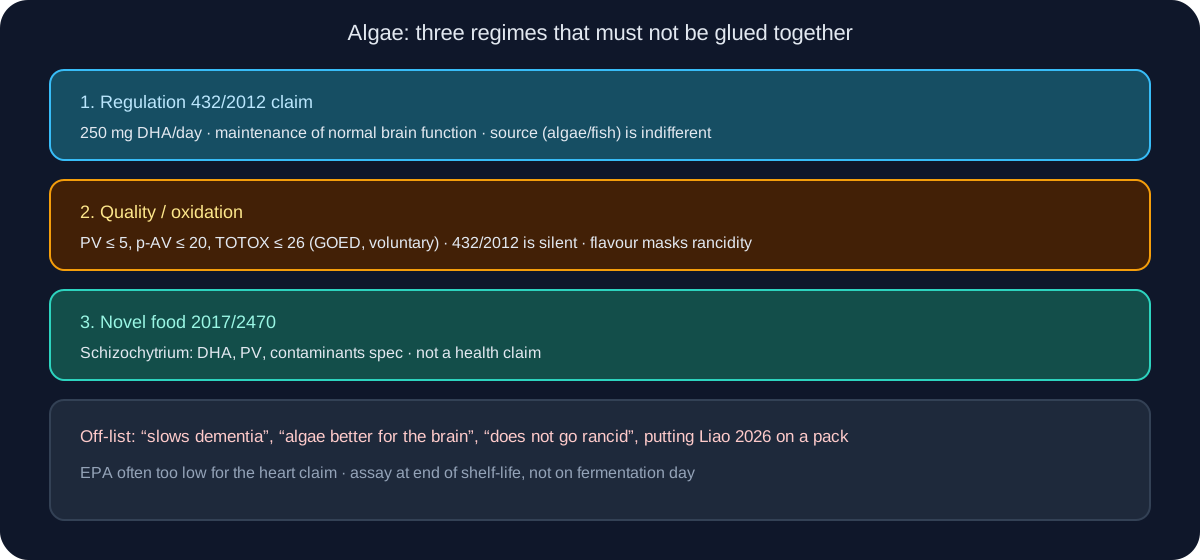
GOED (voluntary, not EU law): PV ≤ 5 meq O₂/kg, p-AV ≤ 20, TOTOX ≤ 26. Jackowski et al. (Journal of Dietary Supplements, 72 US products 2014–2020, including 10 algal): median algal TOTOX was lower than fish (~12.9 vs 41), but 68% of flavoured products exceeded TOTOX 26. Lemon flavour masks rancidity on algae as on fish. Albert et al. (Sci Rep 2015;5:7928) showed New Zealand fish oils frequently over limit — a supply-chain warning, not a species warning.
Regulation 432/2012 does not set a TOTOX condition for the brain claim. A product may legally carry the wording if 250 mg DHA is still present. Oxidised DHA is no longer fully DHA; 4-HNE and MDA are a safety question, not a claim question. End-of-shelf-life assay — not a certificate from press day — decides whether the labelled dose still exists.
4.3. EPA deficit
Typical Schizochytrium oil is DHA-rich, with EPA trace or a few percent. The brain claim is DHA-specific: algae meet 250 mg DHA in a small capsule more easily. The heart claim needs EPA+DHA. A pack that wants both must add the acids or use an EPA+DHA strain (separate novel-food entries). Low EPA is not a defect of the brain claim; it is a defect of “full omega-3 like fish”.
4.4. Novel food is a specification, not freshness on the shelf
Schizochytrium oil is a novel food. The 2017/2470 entry sets DHA content, acid value, PV, unsaponifiables, contaminants. A product outside that specification is not a legal ingredient even if the label says “algae DHA”. EFSA’s safety envelope (supplemental EPA+DHA up to 5 g/day in adults; DHA alone about 1 g/day — EFSA 2012) is not a brain claim and does not assess a rancid lot after 18 months in a warm warehouse.
4.5. Form: triacylglycerols, not ethyl esters
Algal oil typically leaves the fermenter as triacylglycerols (TAG), not ethyl esters (EE). Versus some fish EE concentrates that is a plus for oxidative stability at the start — not a shield. Six double bonds remain; TAG does not waive end-of-shelf-life PV/TOTOX and does not open a “does not oxidise” claim. Headspace oxygen, light, fermentation and extraction temperature, tocopherol mix, nitrogen flush, enteric coat (which in Jackowski did not guarantee better TOTOX) are process choices. “Refrigerate after opening” does not repair PV from packing day.
4.6. Contaminants: a different profile, not zero risk
Methylmercury and marine-chain PCBs are typically lower in fermentation oil. Residues of media, solvents, variable iodine, sterols, metals from culture, leftover biomass remain. That is a HACCP/specification argument, not a “detox from the ocean” line on pack.
4.7. Bioavailability ≠ a superiority claim
Plasma-phospholipid comparisons over 6–14 weeks (algae vs fish, 2025) show similar EPA/DHA bioavailability. Similar bioavailability is not an authorised claim of “better absorbed”, “more effective for memory”.
4.8. Liao did not test algae
ADNI is largely US “fish oil” in interview. No source stratification. DO-HEALTH tested 1 g/day algal omega-3 in people ≥70 and reported epigenetic-clock slowing on the order of four months — different endpoint, RCT, different population. Neither paper opens a claim “algae protect the 70-year-old brain”.
5. What a manufacturer may write
- 432/2012 — authorised wording and dose only. “From algae” is composition (FIC), not a new benefit.
- Not: “slows dementia”, “restores memory”, “better than fish for the brain”, “does not go rancid”.
- Do not transfer Liao 2026 onto a competitor’s pack or onto an algal SKU as “that is why algae”.
- Quality — PV/TOTOX, DHA at end of shelf-life, 2017/2470. Due diligence, not a claim.
- Population — the Art. 13 brain claim is not targeted at MCI/AD. The Art. 14 development claim is pregnancy/lactation, not median age 73.
Sources
- Liao Z-B et al. J Prev Alzheimers Dis 2026;13(6):100569. doi:10.1016/j.tjpad.2026.100569
- Reg. (EC) No 1924/2006 — CELEX:32006R1924
- Reg. (EU) No 432/2012 — CELEX:32012R0432
- Reg. (EU) No 440/2011 — CELEX:32011R0440
- Implementing Reg. (EU) 2017/2470 — CELEX:32017R2470
- EFSA NDA. EFSA Journal 2010;8(10):1734. doi:10.2903/j.efsa.2010.1734
- Albert BB et al. Sci Rep 2015;5:7928. doi:10.1038/srep07928
Educational material, not medical advice and not an assessment of a specific lot. Evidence layer: .