The short legal point: lutein and zeaxanthin have no authorised health claim in the European Union. An MPOD meta-analysis and an NHANES cohort may be cited in an educational text. They do not open a label, a product page or an advertisement.
What did Siim Land write?
On 5 September 2026 Siim Land (@siimland) stacked three layers that science communication often treats as one, and claim law never does:
- higher circulating carotenoid levels are associated with lower all-cause and cardiovascular mortality — citing PMID 36752230;
- lutein and zeaxanthin at 5–20 mg/day improve MPOD, while doses below 5 mg/day are ineffective — citing a 46-study meta-analysis, PMID 34157098;
- cognition papers (including PMIDs 34527222, 36997905, 30326796 and a supplement trial, PMID 33540909).
As a popular-science thread, it is readable. The problem starts when the same shorthand lands on a pack as “lutein for the eyes”, “screen protection” or “heart support”. Regulation (EC) No 1924/2006 does not ask how many likes a post collected. It asks whether a specific food–health relationship has been authorised.
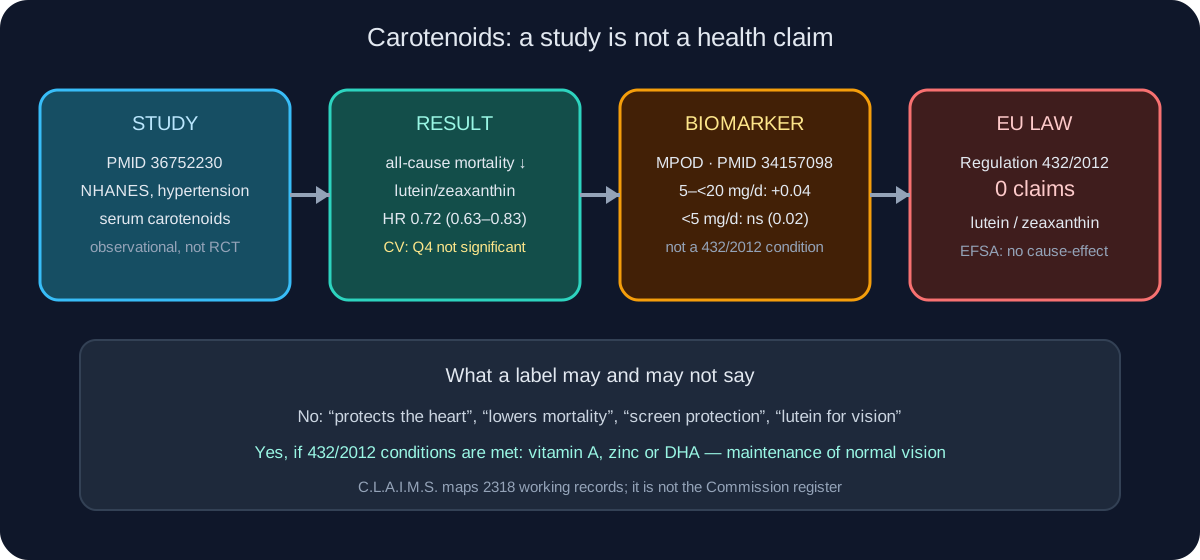
Fig. 1. Study, biomarker and law are three separate layers. An arrow is not a Commission authorisation.
What did the mortality paper actually show?
Zhu et al. in the Journal of the American Heart Association (2023; DOI 10.1161/JAHA.122.027568; full text: PMC10111495) analysed NHANES in 8,390 adults with hypertension, median follow-up 16.6 years, 4,005 all-cause deaths and 1,205 cardiovascular deaths. It is not a general-population sample and it is not randomised.
Highest versus lowest serum quartile, after multivariable adjustment, for all-cause mortality:
- α-carotene HR 0.63 (0.56–0.71);
- β-carotene HR 0.70 (0.61–0.80);
- β-cryptoxanthin HR 0.67 (0.58–0.76);
- lycopene HR 0.74 (0.64–0.86);
- lutein/zeaxanthin HR 0.72 (0.63–0.83).
For cardiovascular mortality, a significant fourth-quartile reduction was seen for α-carotene (HR 0.68), β-cryptoxanthin (HR 0.71) and lycopene (HR 0.74). For β-carotene and for lutein/zeaxanthin, the cardiovascular association in the highest quartile was not significant. A tweet that assigns “lower cardiovascular mortality” to carotenoids as a group blurs that split.
MPOD is a biomarker, not a claim
The second pillar is the meta-analysis by Wilson et al. in Advances in Nutrition (2021;12(6):2244–2254; PMC8634499): 46 studies, 3,189 participants, mean age 43. Combined lutein/zeaxanthin:
- below 5 mg/day — MPOD change 0.02; interval (−0.01 to 0.05), not significant; mainly dietary interventions of 3–6 months;
- 5 to <20 mg/day — MPOD increase of 0.04 units (0.02–0.07);
- ≥20 mg/day — increase of 0.11 units (0.06–0.16), typically 3–12 months.
MPOD measures macular pigment optical density. It is not “maintenance of normal vision” as EFSA uses that phrase, and it is not “protection from screen time”. The authors themselves call for work on the dose and duration that would change visual function, not only a biomarker. “Doses <5 mg/day are ineffective” refers to MPOD in that meta-analysis. It is not a condition of use for a claim, because there is no lutein claim.
Zero entries in 432/2012. That is a refusal, not a gap
A health claim in commercial communication needs the regime of Regulation (EC) No 1924/2006. The list of claims other than disease-risk reduction and children’s development is Commission Regulation (EU) No 432/2012 — about 240 entries. C.L.A.I.M.S. (app.foodlaw.ai) searches 2,318 working records (2,078 SANCO/11074/2013 + 240 from 432/2012), but it is not the Commission’s official register. A/B/C in the tool is an internal taxonomy, not a legal category.
For lutein and zeaxanthin the path is not “on hold”, as it is for some botanicals. It is a path that was assessed and closed with a refusal:
| Act / opinion | Substance | Relationship | Outcome |
|---|---|---|---|
| EFSA Journal 2011;9(4):2039 ID 1606 | lutein + zeaxanthin | maintenance of normal vision | cause and effect not established |
| EFSA Journal 2012;10(6):2716 ID 1603, 1604 (further assessment) | lutein | maintenance of normal vision | evidence insufficient; one intervention showed no effect on visual acuity or glare sensitivity |
| EFSA Journal 2014;12(7):3753 Art. 13(5) | lutein + zeaxanthin | improved vision under bright light conditions | cause and effect not established |
| EFSA Journal 2018;16(1):5138 + Reg. (EU) 2021/77 | NWT-02 (lutein + zeaxanthin + DHA in egg yolk) | “Consumption of NWT-02 reduces loss of vision” | authorisation refused |
In 2012 the NDA Panel found lutein sufficiently characterised and “maintenance of normal vision” a beneficial physiological effect. What was missing was proof that eating lutein produces that effect. In 2014 the Panel separated an MPOD increase from visual function: several studies measured macular pigment but not vision. In 2018 NWT-02 was standardised at ≥1.10 mg lutein, ≥0.20 mg zeaxanthin and ≥170 mg DHA — and the Commission still wrote the refusal into Regulation 2021/77.
The workaround the industry already uses: vitamin A, zinc, DHA
The absence of a lutein claim does not mean a lutein-containing product can carry no vision claim at all. It can — if the formula includes a substance that does appear in 432/2012 and that substance’s conditions are met. The usual three:
- Vitamin A — “contributes to the maintenance of normal vision”; condition: 15% of the nutrient reference value.
- Zinc — the same vision wording; condition: 15% NRV.
- DHA — “contributes to the maintenance of normal vision”; condition: 250 mg DHA per day.
The workaround is lawful only if the claim rests on the listed substance and lutein is not presented as its vehicle. “Lutein with vitamin A for vision” that attributes the effect to lutein is still a lutein claim. β-carotene is also not a lutein-style eye claim: it is a form of vitamin A in Annex II to Regulation 1925/2006, so it sits in the vitamin A regime, not in a non-existent lutein claim.
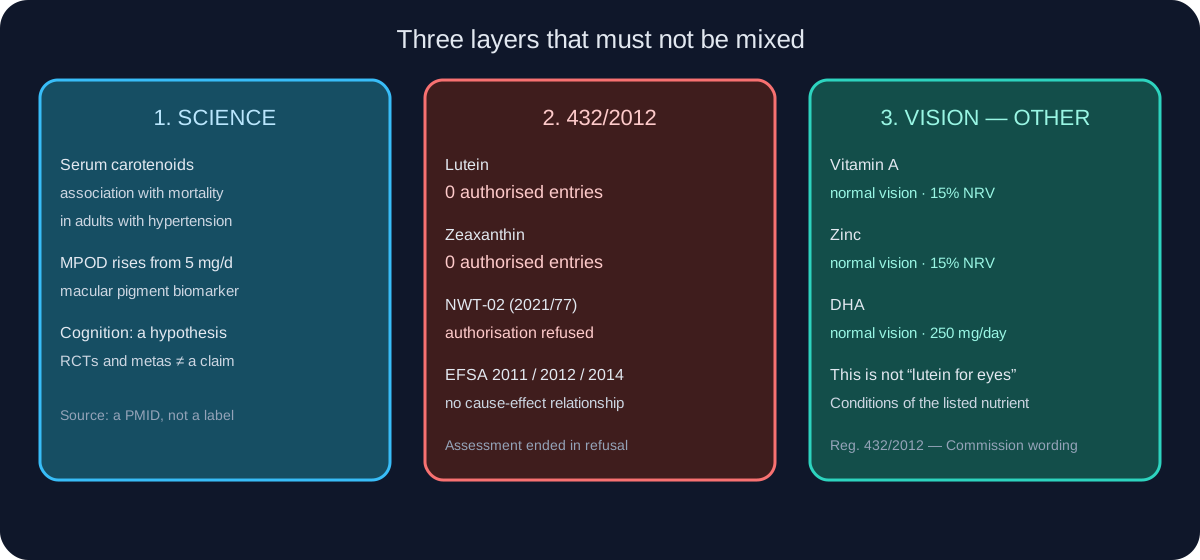
Fig. 2. Science, the 432/2012 list, and other substances’ claims. Mixing the columns is the usual error on an “eye health” pack.
Lycopene, novel food, “screen protection”
Lycopene in Zhu showed a significant association with both all-cause and cardiovascular mortality. Under the claims regime that changes nothing: EFSA did not substantiate lycopene claims on DNA protection, skin or heart. Novel-food status is a third shelf. Whether a lutein source (including tagetes extracts) may be placed in a supplement is a market-access question. It does not decide what may be said about it. A novel-food authorisation is not an entry in 432/2012.
“Screen protection”, “blue-light filter” and “support during long monitor work” are health claims or medicinal claims, depending on the wording. There is no authorised lutein version of any of them. MPOD as a blue-light filter is a mechanism discussed in the literature, not text from the 432/2012 annex.
How to write about lutein without making a claim
- Keep the PMID off the label. In an article, a training note or a legal opinion you may cite Zhu, Wilson, EFSA and 2021/77. On pack, only what follows from 1924/2006 and 1169/2011 remains.
- Check 432/2012 for lutein and zeaxanthin separately. Zero authorised entries. Do not hunt for a licence in SANCO on-hold, and do not treat C.L.A.I.M.S. as a Commission decision.
- Do not put a mortality HR on pack. Even a correctly quoted HR of 0.72 does not open a death, heart or “longevity” claim.
- Do not treat 5–20 mg/day as a condition of use. That dose comes from an MPOD meta-analysis. A product may contain 10 mg lutein; that does not authorise “supports vision at a clinical dose”.
- Take a vision claim from vitamin A, zinc or DHA — with their wording and conditions. Lutein stays an ingredient, not the subject of the claim.
- C.L.A.I.M.S. is the start of an audit. 2,318 working records. The legal basis is confirmed in the EU Register of Health Claims and in the text of 432/2012.
Conclusion
The carotenoid thread is a useful reminder that plant foods and macular pigment are the subject of serious literature. It is also a compliance test. Lutein and zeaxanthin were assessed by EFSA and did not enter the 432/2012 list. A hypertensive NHANES analysis does not transfer onto a “for the heart” label. An MPOD increase at 5–20 mg/day is not a legal condition of a vision claim. If the product is to speak about vision, vitamin A, zinc or DHA speak — and only in their sentences.
Sources and further reading
- Siim Land, thread of 5 September 2026, post 2096318143530467440 — starting point: carotenoids, MPOD, cognition.
- Zhu et al., JAHA 2023;12(4):e027568, PMC10111495 — NHANES, 8,390 adults with hypertension; PMID 36752230.
- Wilson et al., Adv Nutr 2021;12(6):2244–2254, PMC8634499 — MPOD, 46 studies, N=3,189; PMID 34157098.
- EFSA Journal 2011;9(4):2039 — ID 1606, lutein + zeaxanthin, vision.
- EFSA Journal 2012;10(6):2716 — ID 1603, 1604, lutein, further assessment.
- EFSA Journal 2014;12(7):3753 — lutein + zeaxanthin, vision under bright light, Art. 13(5).
- EFSA Journal 2018;16(1):5138 and Regulation (EU) 2021/77 — NWT-02 refused.
- Regulation (EU) No 432/2012 — authorised-claims list; vitamin A, zinc, DHA.
- EU Register of Health Claims — the Commission register, not C.L.A.I.M.S.
- C.L.A.I.M.S. (app.foodlaw.ai) — 2,318 working records (2,078 SANCO + 240 from 432/2012); a tool, not a Commission decision.
- CJEU, C-386/23, Novel Nutriology, 30 April 2025 — on-hold ≠ authorisation (a different track from lutein).
- Health claims — guide (PL).
Comparison: study vs 432/2012 vs workaround
| Layer | What it is | What it is not |
|---|---|---|
| PMID 36752230 | Observation in adults with hypertension; lutein/zeaxanthin all-cause HR 0.72; CV in Q4 not significant | “Protects the heart”, “lowers mortality” on pack |
| PMID 34157098 | MPOD: <5 mg/d ns; 5–<20 mg/d +0.04; ≥20 mg/d +0.11 | Treating 5–20 mg as a 432/2012 condition; “screen protection” |
| 432/2012 | 0 entries for lutein and zeaxanthin; NWT-02 refused in 2021/77 | Treating the EFSA assessment as “not yet listed” |
| Vit. A / zinc / DHA | Authorised maintenance-of-vision claims (15% NRV or 250 mg DHA/day) | Attributing the effect to lutein |
| C.L.A.I.M.S. | 2,318 working records (2,078 SANCO + 240 from 432/2012) | The Commission register; A/B/C as law |
Glossary
- MPOD
- Macular pigment optical density. A biomarker, not a health claim.
- Reg. 432/2012
- The list of authorised health claims (about 240 entries). Separate from the SANCO on-hold dossier.
- NWT-02
- A lutein + zeaxanthin + DHA combination in egg yolk. “Reduces loss of vision” — refused in Regulation (EU) 2021/77.
- C.L.A.I.M.S.
- A search tool for 2,318 records (2,078 SANCO/11074/2013 on-hold + 240 from 432/2012) at app.foodlaw.ai. Not the official Commission register. A/B/C = tool taxonomy.
- Art. 7(3) FIC
- Regulation (EU) No 1169/2011: food information shall not attribute to foods the property of preventing, treating or curing a human disease.
Evidence layer last updated: . Separately, as food rather than a supplement: maize — lutein, zeaxanthin, ferulate and resistant starch versus 432/2012.