The legal point is narrow: maize carries interesting constituents, but those constituents do not give a manufacturer an EU health claim. Popular pieces on “feeding the gut” and “protecting the macula” describe mechanisms and doses from other products. Regulation (EC) No 1924/2006 asks for an authorised food–health relationship, not for how long the crop has been grown.
1. What is actually in maize?
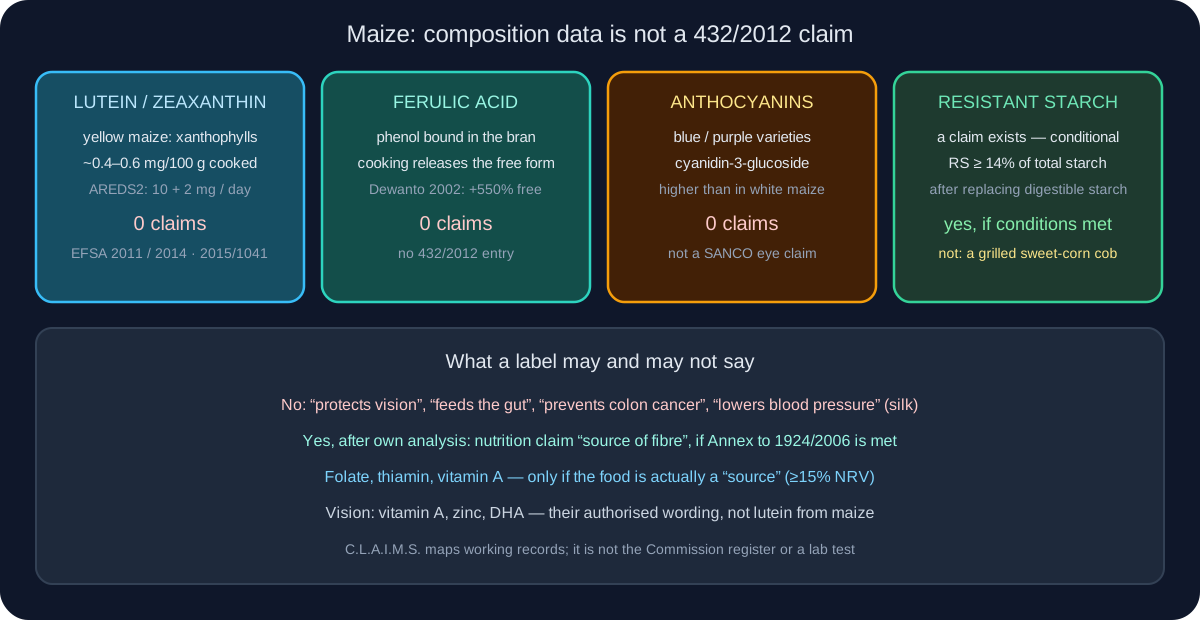
Whole maize grain (Zea mays) supplies mainly starch, protein low in lysine and tryptophan, germ oil, and bran fibre. Yellow and orange types carry carotenoids. Holden et al. in the USDA-NCI carotenoid database (1999) reported that in the yellow maize types analysed lutein and zeaxanthin made up the dominant share of measured carotenoids (in that database — more than 85% of the pool, lutein about 60% of that share). That is not a universal property of every maize. Perry, Rasmussen and Johnson (Journal of Food Composition and Analysis, 2009) split the two xanthophylls: cooked corn from frozen held 202 µg/100 g of each (about 0.404 mg/100 g combined). Values depend on variety, product form and processing. Yellow cornmeal was much higher (about 1001 µg lutein and 531 µg zeaxanthin per 100 g); white cornmeal was negligible.
Published tables and studies put boiled sweet corn at roughly 0.4–0.6 mg lutein and zeaxanthin combined per 100 g. USDA FoodData Central is in the 0.6 mg/100 g range, with fibre about 2.4 g/100 g and folate about 23 µg/100 g. Those composition figures are indicative only. They do not replace batch analysis, are not an AREDS2 dose and are not a condition of use for a claim.
2. Gut: fibre, resistant starch, butyrate
Insoluble bran fibre adds stool bulk. Resistant starch that escaped small-intestinal digestion can be fermented in the colon to short-chain fatty acids, including butyrate. A 2021 review in Frontiers in Microbiology (PMC8117019) maps those microbiota interactions. A separate line of work concerns type-2 resistant starch from high-amylose maize in processed foods — including International Journal of Molecular Sciences (2022, PMC9180756). That is not a typical sweet-corn cob.
The 432/2012 list does contain a resistant-starch claim: replacing digestible starches with resistant starch in a meal contributes to a reduction in the blood glucose rise after that meal. Condition: final resistant starch is at least 14% of total starch (EFSA Journal 2011;9(4):2024, ID 681). The opinion grew out of RS2 from high-amylose maize. Typical sweet corn, in particular an ordinary cob, is not as a rule a product designed to meet that condition; what decides is analysis of the specific product. A manufacturer who wants the claim must formulate so the condition is met after substitution — and be able to show it analytically.
3. Eye: lutein and zeaxanthin with no claim
Lutein and zeaxanthin deposit in the macula. That is physiology, repeated for years in the nutrition literature. It does not open a label. The NDA Panel in 2011 assessed lutein plus zeaxanthin and maintenance of normal vision (ID 1606, EFSA Journal 2011;9(4):2039) and did not establish cause and effect. In 2014 the same panel assessed lutein plus zeaxanthin and improved vision under bright light (EFSA Journal 2014;12(7):3753): the one study from which conclusions could be drawn showed no effect. Commission Regulation (EU) 2015/1041 refused authorisation. Separately, NWT-02 (lutein + zeaxanthin + DHA in egg yolk) — Regulation (EU) 2021/77.
The MPOD meta-analysis and the mortality cohort PMID 36752230 are unpacked in Carotenoids, lutein and zeaxanthin: zero 432/2012 claims. Here the dose from maize is what matters.
AREDS2 (JAMA 2013, PMID 23644932) used 10 mg lutein + 2 mg zeaxanthin per day as a supplement intervention. At an indicative 0.4–0.6 mg lutein and zeaxanthin combined per 100 g of boiled sweet corn, a cob is not an AREDS2 equivalent. Biofortified deep-orange types can raise zeaxanthin by an order of magnitude versus standard — still a food, not a condition of use for a claim that does not exist.
4. Antioxidants: ferulate and heat
Most ferulic acid in maize is bound in cell walls. Dewanto, Wu and Liu (Journal of Agricultural and Food Chemistry, 2002, 50(17):4959–4964) heated sweet corn at 115°C for 25 min: total antioxidant activity rose 44%, free ferulic acid 550%. Later high-pressure boiling work reports 20–42% increases in carotenoids and polyphenols as cell structures break. That is an argument for cooking, not for “powerful antioxidant” on pack.
Ferulic acid has no authorised health claim. Laboratory and animal work on vessels, cholesterol or glycaemia stays in the literature. In labelling, advertising and commercial communication those findings are not transferred as a benefit of a named product. An educational article may describe the studies if it does not present them as a product claim.
5. Corn silk and nixtamalisation
Corn-silk extract lowered blood pressure in rat models and shifted the microbiome in other animal papers. Three separate points: (1) no authorised health claim; (2) attributing a medicinal effect — lowering blood pressure or treating hypertension — is prohibited; (3) the status and safety of the extract as a supplement ingredient is a separate question and does not open a claim. An animal-model signal is not enough for a food or supplement label.
Nixtamalisation — alkaline steeping used for tortillas and arepas — increases the bioavailability of bound niacin in maize. Niacin has authorised claims (including normal energy-yielding metabolism), but only if the food is a “source of niacin” under the 1924/2006 Annex. As a practical assessment, European sweet corn without nixtamalisation usually does not carry that. That is not a legal conclusion in advance — niacin content in the specific product decides.
6. Table: science versus the EU label
| Constituent / topic | What the literature shows | 432/2012 and 1924/2006 |
|---|---|---|
| Lutein + zeaxanthin | Macular xanthophylls; indicative 0.4–0.6 mg/100 g boiled sweet corn (varies with type and processing); AREDS2: 10+2 mg | No authorisation. EFSA 2011 (ID 1606), 2014; Reg. 2015/1041, 2021/77 |
| Ferulic acid | Bound phenol; heat frees it (Dewanto 2002) | No health claim |
| Anthocyanins in pigmented types | Higher antioxidant potential than white maize | No “eye” / “gut” claim from maize |
| Resistant starch | Fermentation to SCFA; high-amylose RS2 in formulated foods | Yes: post-prandial glucose, if RS ≥ 14% of total starch after substitution |
| Fibre | ~2.4 g/100 g boiled sweet corn (USDA — indicative) | Nutrition claim “source of fibre” possible at 3 g/100 g or 1.5 g/100 kcal — after batch analysis and actual energy value |
| Folate | ~23 µg/100 g (indicative); NRV 200 µg | “Source of folate” requires at least 15% NRV in the reference quantity set by the rules — as a rule per 100 g or 100 ml, and in specified cases also per portion. A typical cob usually misses the threshold |
| Corn silk | Animal models (blood pressure, microbiome) | No authorised health claim; medicinal language prohibited; extract status/safety is separate |
7. What may a manufacturer say?
Composition, the food category, and nutrition claims the product meets after analysis. Authorised claims for other substances if those substances — not lutein from maize — are the subject of the claim and the condition is met (vitamin A, zinc, DHA: maintenance of normal vision; niacin, thiamin: their own entries). The resistant-starch claim only on a product that meets 14% after substitution and has analytics for it.
In labelling, advertising and commercial communication, mechanisms are not transferred as a product benefit with wording such as “protects vision”, “macular pigment”, “blue-light protection”, “feeds the microbiome”, “prevents constipation / colon cancer”, “lowers cholesterol / sugar / blood pressure”, “antioxidant protecting cells” — if the vehicle is maize, lutein, zeaxanthin, ferulate or silk. Article 10(1) of Regulation 1924/2006 does not ask how many meta-analyses the marketing team collected.
The word “prebiotic” needs a product-specific assessment: on a pack and in advertising it will often be a health claim requiring authorisation. A scientific mention of prebiotic potential in an educational text is a different regime from a product claim — provided it is not attributed to a named product in commercial communication.
Conclusion
Maize is an old grain with a measurable composition: fibre, resistant starch in specific matrices, lutein and zeaxanthin in yellow types, ferulate released on cooking, anthocyanins in pigmented types. EU claims law cut that list off from the label. Lutein and zeaxanthin were assessed and refused. Ferulate and maize anthocyanins never entered 432/2012. Resistant starch entered — with a 14% condition after substitution. Typical sweet corn is not a product designed to meet it; analytics of the specific food decide. A manufacturer who wants to talk about vision, the gut or glycaemia must enter another substance, another product or their own application, not a cob from a popular-science article.
Sources
- Holden JM et al., JFCA 1999;12:169–196 — carotenoid database; in the yellow maize types analysed, lutein and zeaxanthin dominated the pool.
- Perry A, Rasmussen H, Johnson EJ, JFCA 2009;22:9–15 — separate lutein and zeaxanthin (cooked from frozen: ~202 µg/100 g each, ~0.404 mg/100 g combined).
- Dewanto V, Wu X, Liu RH, J Agric Food Chem 2002;50(17):4959–4964 — heat, free ferulic acid and antioxidant activity.
- EFSA NDA, EFSA Journal 2011;9(4):2024 — resistant starch and post-prandial glycaemia (ID 681). doi:10.2903/j.efsa.2011.2024
- EFSA NDA, EFSA Journal 2011;9(4):2039 — lutein + zeaxanthin, maintenance of vision (ID 1606). doi:10.2903/j.efsa.2011.2039
- EFSA NDA, EFSA Journal 2014;12(7):3753 — lutein + zeaxanthin, bright-light vision. doi:10.2903/j.efsa.2014.3753; Reg. (EU) 2015/1041.
- Commission Regulation (EU) No 432/2012 — Article 13 list.
- Chew EY et al., AREDS2, JAMA 2013;309:2005–2015, PMID 23644932.
- Commission Decision 2013/49/EU — synthetic zeaxanthin as novel food in supplements, up to 2 mg/day.
- Regulation (EC) No 1924/2006 — nutrition and health claims; Annex: “source of fibre”, “source of [vitamin/mineral]” (≥15% NRV in the reference quantity).
- Regulation (EU) 2021/77 — NWT-02 (lutein, zeaxanthin and DHA from egg yolk); no authorised claim.
- Carotenoids, lutein and zeaxanthin vs 432/2012 — MPOD, mortality cohort, NWT-02.
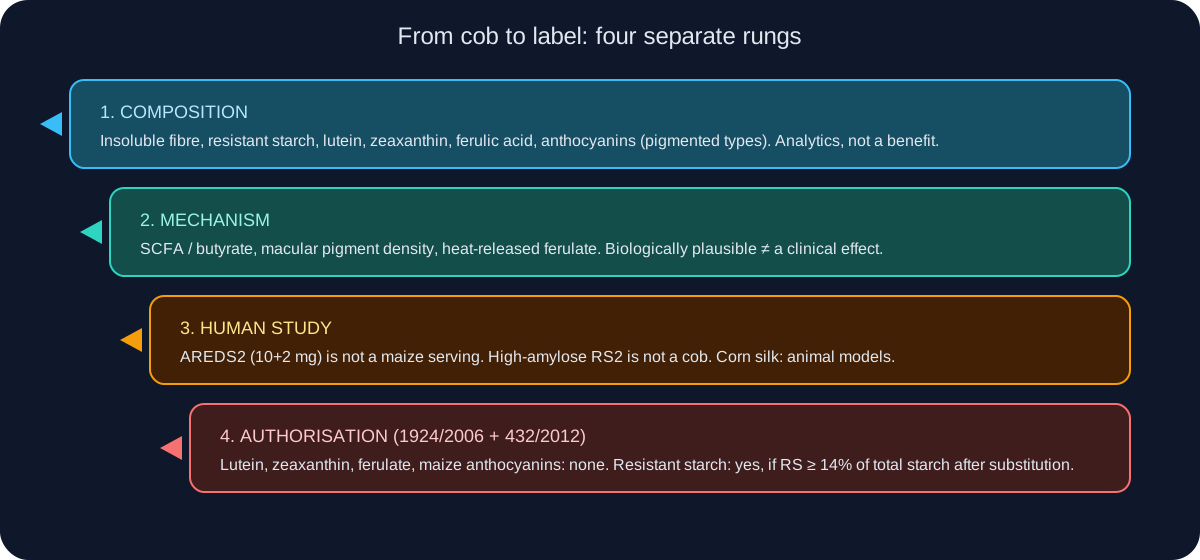
Comparison: literature versus label
| Layer | What an educational text may cite | What a pack may not say |
|---|---|---|
| Composition | mg lutein/100 g, g fibre, variety | Turning composition into a health benefit |
| Mechanism | SCFA, macula, bound/free ferulate | “Feeds the gut”, “protects the macula” |
| AREDS2 / RS2 | Doses and matrices from the papers | Assigning them to a sweet-corn cob |
| 432/2012 | Empty list for lutein/zeaxanthin/ferulate | Inventing a claim “from the literature” |
Glossary
- Health claim (Art. 2(2)(5) Reg. 1924/2006)
- Any claim that states, suggests or implies a relationship between a food category, a food or one of its constituents and health.
- Resistant starch (RS)
- The starch fraction not hydrolysed in the small intestine. The 432/2012 claim requires ≥14% RS of total starch after replacing digestible starch.
- NRV
- Nutrient reference value in Annex XIII to 1169/2011. “Source” of a vitamin or mineral: ≥15% NRV per 100 g or per portion (beverages: 7.5% per 100 ml).
- Nixtamalisation
- Alkaline processing of maize grain that raises niacin bioavailability. Whether the food is a “source of niacin” depends on content in the specific product, not on the process alone.
How to describe maize without creating a claim
- Do not put “for vision” from lutein in maize on a pack or in advertising. The 432/2012 list is empty.
- “Prebiotic” on a pack and in product advertising usually needs authorisation. A scientific mention in an educational text is a different regime from a product claim.
- Resistant starch — only if the specific product meets 14% after substitution and has analytics for it.
- Nutrition claim — after batch analysis and actual energy value; USDA tables are indicative only.
- Silk — no health claim; medicinal language (blood pressure, hypertension) prohibited; extract status is separate.
Evidence layer last updated: .