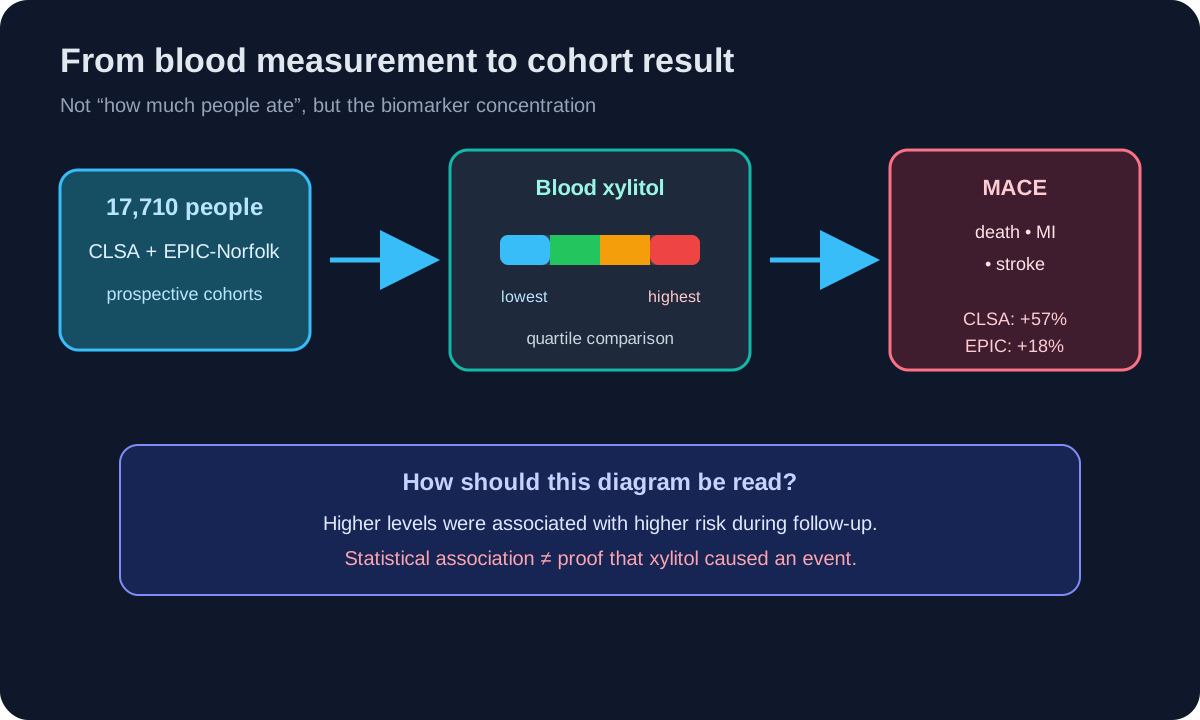
The fairest short version is this: among 17,710 participants, people in the highest blood-xylitol quartile had more composite cardiovascular events than those in the lowest quartile — 57% higher in CLSA over about six years and 18% higher in EPIC-Norfolk over about 30 years. This does not mean that every xylitol product causes a heart attack or stroke.
1. Where do these numbers come from?
The result comes from a study presented at ESC Congress 2026 under the title The association of Xylitol and incident cardiovascular events: the CLSA and EPIC-Norfolk cohort studies. The team used two prospective cohorts: the Canadian Longitudinal Study on Aging (CLSA) and the European Prospective Investigation into Cancer – Norfolk (EPIC-Norfolk). The official European Society of Cardiology description reports 17,710 participants, a highest-versus-lowest quartile comparison and a composite outcome of death, myocardial infarction or stroke.
This editorial distinction matters: at publication time, this specific cohort result is available as a conference presentation and official study description, not as a full peer-reviewed results paper. The figures should therefore be presented as preliminary conference data, not as a final clinical consensus.
2. What do 57% and 18% mean?
| Cohort | Comparison | Observed result | Outcome included |
|---|---|---|---|
| CLSA | Highest vs lowest blood-xylitol quartile | 57% higher risk over about 6 years | Death, myocardial infarction or stroke |
| EPIC-Norfolk | Highest vs lowest blood-xylitol quartile | 18% higher risk over about 30 years | The same composite outcome |
The percentage is relative: it describes a difference between groups, not the number of additional heart attacks expected for an individual. Without the full tables, event counts, confidence intervals and absolute risks, it cannot be converted into a personal probability. The ESC description also reports adjustment for major risk factors and a suggested dose–response pattern, but adjustment does not remove the core limitations of an observational study.
3. Blood concentration is not the same as intake
The analysis measured blood xylitol, not food diaries showing how much participants consumed. Xylitol is a polyol: small amounts occur in some natural foods and it is also produced during human metabolism, while larger amounts are added to foods, sweets, gum and oral-care products. A single measurement therefore does not automatically answer whether a particular serving of gum or dessert raises long-term risk.
Nor should the highest quartile be described as “people who ate the most xylitol”. It was the highest biomarker quartile. Concentrations may reflect endogenous production, excretion, kidney function, metabolism, time since exposure and other factors.
4. What does the earlier 2024 primary study add?
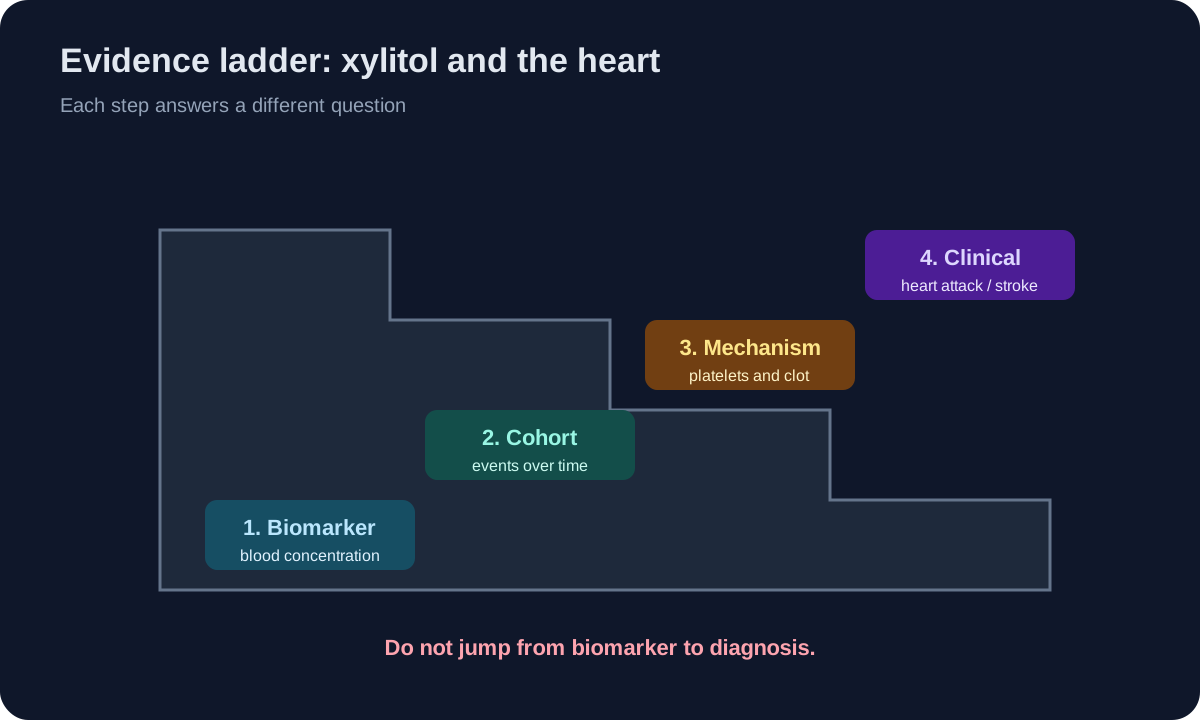
The key peer-reviewed reference is Witkowski et al. in European Heart Journal (2024;45:2439–2452; DOI 10.1093/eurheartj/ehae244). The authors used, among other designs, an independent validation cohort of 2,149 people, platelet and whole-blood experiments, a mouse thrombosis model and a controlled challenge in 10 healthy volunteers.
5. What do these data not prove?
- They do not prove causality. Even adjustment for age, sex, smoking, lipids, diabetes, hypertension and BMI may leave residual confounding.
- They do not establish a dose. They do not show how much xylitol is safe or harmful per day.
- They do not evaluate every use. Gum, toothpaste, medicines, sweetened desserts and pure xylitol can produce different exposures.
- They do not settle the benefit–risk balance. The signal concerns possible cardiovascular risk; it does not automatically invalidate dental uses, but it warrants further research.
The difference between observational and randomized research is central. In a cohort, researchers measure baseline characteristics and observe what happens next; they do not randomly assign people to consume xylitol for decades. The association could be causal, could mark another process or could partly reflect unmeasured differences between groups.
6. What should a reader do with the information?
There is no basis for stopping treatment, making risky dietary changes or treating all xylitol products as equally dangerous on the basis of one conference result. A sensible step is to read ingredient lists and avoid assuming that “sugar-free” automatically means “risk-free”. People with cardiovascular disease, diabetes, kidney disease or regular high exposure to polyol-sweetened products can discuss their choices with a clinician or dietitian.
Xylitol is also highly toxic to dogs. Keep products containing it away from pets; suspected ingestion requires immediate veterinary advice. That is a separate, established toxicology issue and should not be confused with the human cardiovascular interpretation.
Conclusion
The CLSA and EPIC-Norfolk analysis is an important signal for further research: higher blood xylitol levels were associated with more composite cardiovascular events, with a highest-versus-lowest quartile difference of 57% in CLSA and 18% in EPIC-Norfolk. Because the result is observational conference evidence, it must not be translated into proof that xylitol causes heart attacks or strokes. The strongest defensible message is that full data, independent replication, food-exposure studies and long-term safety research are needed.
Primary sources and further reading
- ESC Congress 2026: The association of Xylitol and incident cardiovascular events: the CLSA and EPIC-Norfolk cohort studies — official description of the 26 August 2026 presentation; source for the 17,710, 57% and 18% figures.
- Witkowski M, Nemet I, Li XS et al. Xylitol is prothrombotic and associated with cardiovascular risk. European Heart Journal. 2024;45:2439–2452. DOI: 10.1093/eurheartj/ehae244. — peer-reviewed observational and mechanistic study.
- PubMed: PMID 38842092 — bibliographic record for the 2024 primary paper.
- ClinicalTrials.gov NCT04731363 — registry for the controlled xylitol challenge in healthy volunteers.
- NIH Research Matters: Xylitol may affect cardiovascular health — independent explanation of the earlier primary study.