The key takeaway is a cautious one: coffee may genuinely modify the gut environment, and its effects are not reducible solely to caffeine blocking adenosine receptors. We do not, however, have grounds to call coffee a therapy, a "microbiome repair agent" or a guarantee of better mood.
What did the new study show?
In a paper published in Nature Communications in 2026 (full text: PMC13100100), 31 people who habitually drank three to five cups of coffee per day were compared with 31 non-coffee drinkers. Participants were healthy adults aged 30–50 living in Ireland. The coffee drinkers then abstained for 14 days, after which they received either caffeinated or decaffeinated coffee for three weeks. The trials are registered as NCT05927038 and NCT05927103.
The researchers combined several types of measurement: microbiome sequencing, faecal and urinary metabolomics, inflammatory markers, cortisol, and tests of mood, sleep, behaviour and memory. This is important, because the study was not designed to answer "does coffee extend lifespan" but rather the narrower question: how do regular consumption, withdrawal and reintroduction of coffee co-occur with physiology and behaviour.
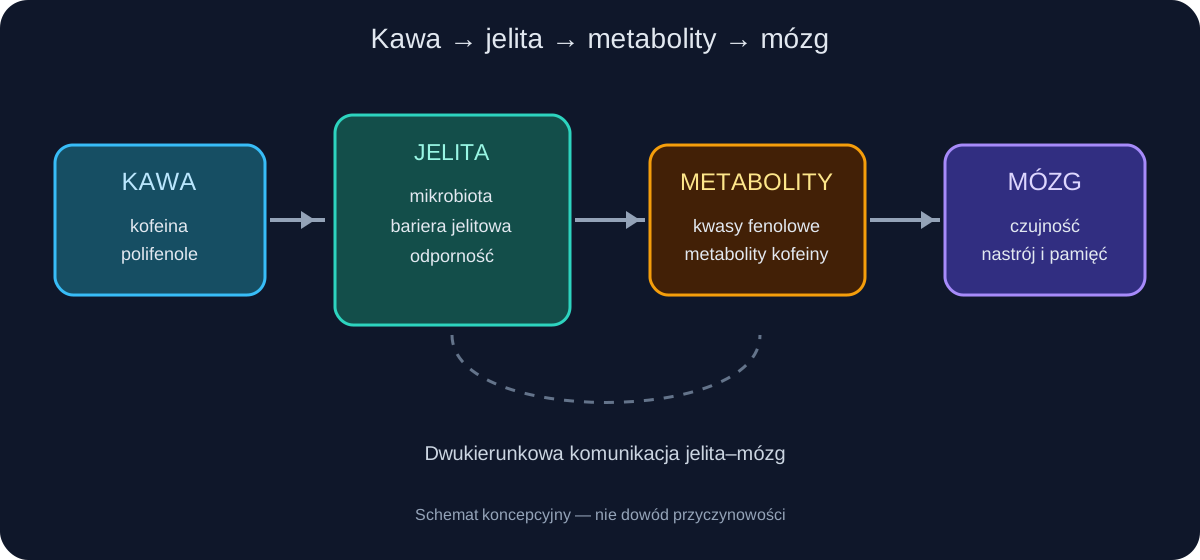
Fig. 1. A schematic of gut–brain communication. This is a biological model, not evidence that every arrow represents confirmed causality.
The most notable observations
- Coffee drinkers differed in certain bacterial strains, including Cryptobacterium curtum and some species of Eggerthella. This does not automatically mean these are "good bacteria" or that they independently explain coffee's effects.
- Both caffeine metabolites and compounds derived from polyphenol metabolism changed in faeces and urine. In some analyses, these effects disappeared after coffee withdrawal and returned upon reintroduction.
- Caffeinated and decaffeinated coffee shared some microbiome-related and mood-related changes. After caffeinated coffee, some psychological and cognitive scores and morning cortisol changed, while the decaffeinated group showed improvement in several measures of sleep, activity and memory.
- Results relating to impulsivity, emotional reactivity and memory were complex. They cannot be reduced to the headline "coffee improves the brain" without significant qualification.
Why might the effect not depend solely on caffeine?
Caffeine blocks adenosine receptors and can therefore increase arousal and reduce the perception of fatigue. Coffee is, however, a mixture of many substances: chlorogenic acids and other polyphenols, alkaloids, melanoidins formed during roasting, and components that may reach the large intestine.
The gut microbiota can transform some polyphenols into smaller metabolites. These in turn may interact with the intestinal epithelium, the immune system and signalling pathways to the nervous system. This is a plausible biological mechanism, but it should not be confused with a confirmed clinical effect. A change in the concentration of a metabolite in faeces is not equivalent to a change in its activity in the brain.
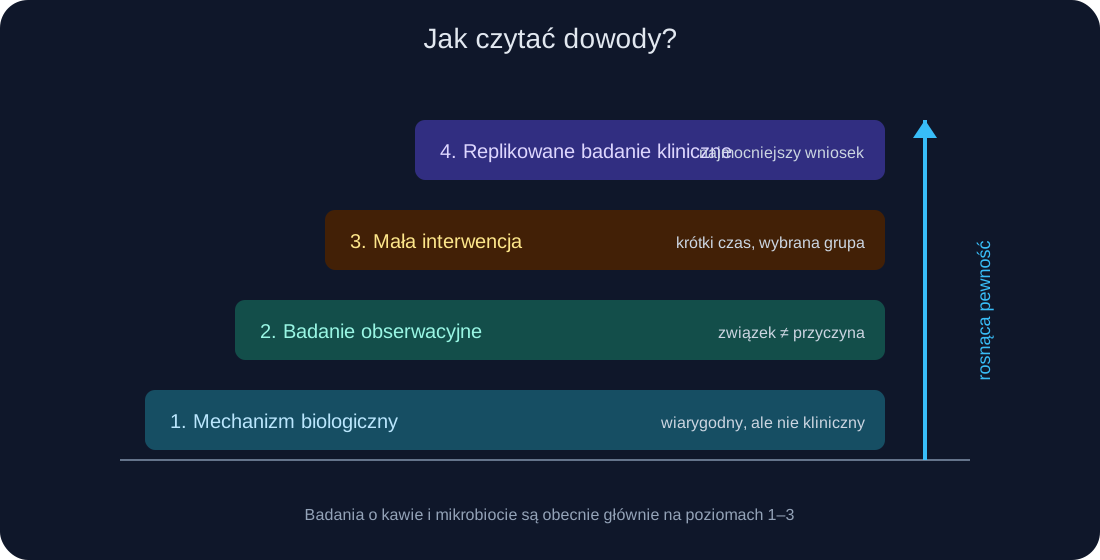
Fig. 2. How to read the evidence: from mechanism and observation to clinical intervention.
What do other studies add?
Decaffeinated coffee: less caffeine, not "zero"
The finding relating to decaffeinated coffee is practically relevant, but it should not become a marketing slogan. In the Cork study, some changes following coffee reintroduction appeared independently of caffeine. At the same time, decaffeinated coffee still contains a small amount of caffeine. According to the FDA, a typical cup of decaffeinated coffee may contain approximately 2–15 mg of caffeine, depending on the product.
If insomnia, palpitations or anxiety are a concern, switching some drinks to decaffeinated versions may be a sensible experiment, but it is worth monitoring your own response. This is not a promise of improved memory or a way of treating mood disorders.
A practical approach to coffee
- Look at total caffeine intake, not just the number of cups. Content varies considerably between brewing methods and drink sizes.
- For most healthy adults, up to 400 mg of caffeine per day is the reference point cited by the FDA, but individual tolerance may be substantially lower.
- Avoid coffee late in the day if it impairs your sleep. Sleep is one of the most direct ways of supporting memory and emotional regulation.
- Do not treat coffee as a food supplement or a probiotic. A varied diet rich in vegetables, legumes, whole grains and fibre provides a better foundation for the gut microbiota than any single beverage.
- Discuss your limit with a doctor if you are pregnant, breastfeeding, have a heart rhythm disorder, severe anxiety, acid reflux, high blood pressure, or take medications whose effects may be altered by caffeine.
Health claims for coffee and caffeine: C.L.A.I.M.S. versus Regulation 432/2012
The Cork findings are not a health claim. Regulation (EC) No 1924/2006 requires a commercial communication about a food–health relationship to rest on the applicable authorisation regime. C.L.A.I.M.S. (app.foodlaw.ai) is a search tool, not the Commission’s official register. The A/B/C labels in the tool are an internal taxonomy, not a legal category.
In the authorised-claims file (240 records from Commission Regulation (EU) No 432/2012, checked on 2 September 2026) there is no authorised health claim for caffeine or coffee. Four EFSA opinions on alertness, attention and endurance were scientifically positive but were never entered as authorised claims. The 75 mg per serving and 3 mg/kg body-weight conditions came from a rejected, non-binding proposal — they are not legal conditions of use. Related analysis: caffeine, coffee and the heart — AHA 2026 and EU law.
The botanical dossier SANCO/11074/2013 (about 2,078 SANCO records in C.L.A.I.M.S.) includes caffeine and Coffea arabica entries. These are on-hold records, not a licence for a label. The CJEU judgment in Case C-386/23, Novel Nutriology (30 April 2025), confirms that “on hold” is not authorisation. Article 28 of Regulation 1924/2006 may, in a specific case, preserve prior use — that requires an analysis of the product, wording, Member State and enforcement practice, not a screenshot from a search tool.
| SANCO ID | Substance | Health relationship (record) | Condition of use in the record | Status |
|---|---|---|---|---|
| 736 / 1485 | Caffeine (from tea/coffee/chocolate or added in pure form) | Cognitive and mental performance — alertness, concentration, “revive you” | min. 32 mg/day | SANCO on hold; not 432/2012 |
| 737 / 1486 | Caffeine | Physical performance (short-term and endurance) | 1–5 mg/kg body weight/day | SANCO on hold; not 432/2012 |
| 1101 | Coffea arabica L. (coffee) | Mental and physical stimulant effect | on average 15 g dried seeds/day | SANCO on hold; not 432/2012 |
| 1187 | Coffee drink / caffeine | “Coffee helps you stay alert. Coffee invigorates.” | ~90 mg/100 g; 110 mg/125 ml; 440 mg/500 ml (daily dose in the record) | SANCO on hold; not 432/2012 |
| 1488 | Caffeine | Endurance, time to exhaustion, perceived exertion | ≥100 mg/serving or 1–5 mg/kg; foods for active individuals | SANCO on hold; not 432/2012 |
| 1490 / 1491 | Caffeine (with or without carbohydrate) | Reduced perception of effort; mental alertness during intense muscular activity | foods for sportspeople (former Directive 89/398); 32 mg/serving or 1–13 mg/kg | SANCO on hold; not 432/2012 |
The wordings in the table are quoted from SANCO records as documentation, not as text to copy onto a label. PMC13100100, record 1187 and a microbiome mechanism do not authorise claims that coffee “repairs the gut”, “treats mood” or “supports the microbiome”.
Conclusion
Coffee is in all likelihood a biologically active beverage, not merely a vehicle for caffeine. The latest study shows that regular consumption may be associated with changes in the microbiota, metabolites, immune markers and behaviour, and that some of these signals also appear with decaffeinated coffee. The most honest interpretation, however, remains: coffee affects the body through multiple pathways, but we do not yet know which changes are causal or who stands to benefit most.
Sources and further reading
- Boscaini et al., Nature Communications (2026), PMC13100100 — primary source: microbiota, metabolites and behaviour; DOI 10.1038/s41467-026-71264-8; NCT05927038 / NCT05927103.
- Nature Communications publisher version — full text and funding declaration (ISIC).
- C.L.A.I.M.S. (app.foodlaw.ai) — search tool for SANCO/11074/2013 and the 432/2012 list; not the Commission register. Records 736, 737, 1101, 1187, 1485–1491 checked on 2 September 2026.
- European Commission: EU Register of Health Claims and Regulation (EU) No 432/2012 — zero authorised caffeine claims.
- CJEU, C-386/23, Novel Nutriology, 30 April 2025 — “on hold” is not authorisation.
- EFSA Journal 2015;13(5):4102 — caffeine safety, including 400 mg/day for most healthy adults.
- Caffeine, coffee and the heart: AHA 2026 statement and EU law.
- González et al., Nutrients (2020) — coffee and faecal microbiota composition in 147 healthy individuals.
- Poole et al., BMJ (2017) — umbrella review of health outcomes associated with coffee consumption.
- FDA: Spilling the Beans — caffeine, individual sensitivity and the 400 mg reference limit.
- Rosa et al., Coffee and Microbiota (2024) — review of mechanisms and limitations of existing research.